



Paediatric Obstructive Sleep Apnea (OSA): When Your Child Snores, Breathes Differently, or Sleeps Restlessly
Contact Us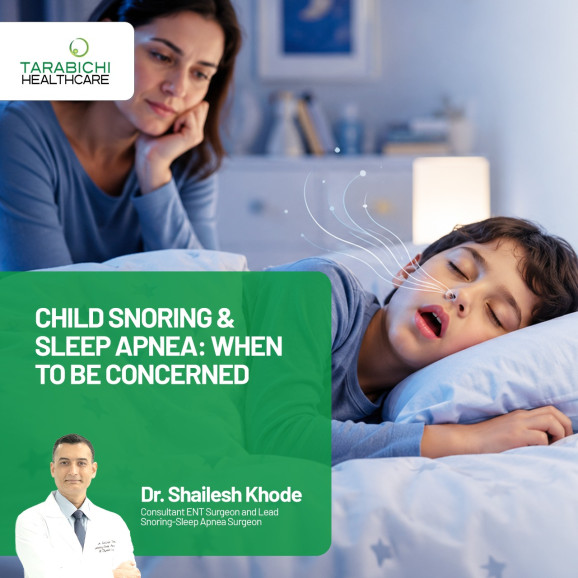
Medically reviewed By Dr. Shailesh Khode | Consultant & Lead Snoring and Sleep Apnea Surgeon, Tarabichi Healthcare
Snoring Is Not Always Normal in Children
Many parents accept their child's snoring as harmless background noise, something they will simply grow out of. In some cases, that is true. Snoring during a cold, or on the odd restless night, rarely signals anything serious.
But when a child snores loudly and regularly, breathes through their mouth at rest, wakes frequently through the night, or shows signs of poor sleep quality, something more significant may be happening.
Obstructive Sleep Apnea (OSA) is a condition in which a child's upper airway repeatedly narrows or blocks during sleep, causing interrupted breathing and disrupted sleep quality.
Unlike adults, children with sleep apnea rarely appear overtly sleepy; instead, the condition often presents as behavioural difficulties, hyperactivity, or poor school performance.
- Hyperactivity and restlessness (often mimicking ADHD symptoms)
- Poor concentration and learning difficulties at school
- Irritability, frequent mood swings, or behavioural problems
- Poor physical growth or delayed weight gain
- Frequent morning headaches
Early diagnosis and intervention are critical. Restorative, uninterrupted sleep is the very foundation of your child’s brain development, physical growth, immune health, and emotional well-being.
Why Does Sleep Apnea Happen? Here are the Causes
Sleep Apnea in Children develops when the upper airway narrows or collapses during sleep, restricting airflow. In children, the underlying causes are often different from those in adults, and identifying the right cause is crucial to choosing the right treatment.
- Enlarged tonsils and adenoids are responsible for the majority of cases in younger children. As throat muscles relax during sleep, these naturally enlarged tissues crowd the airway and disrupt breathing. This is also why adenotonsillectomy has historically been the first-line treatment.
Our Surgical Expertise: While the removal of these tissues (adenotonsillectomy) is the traditional first-line treatment, we utilize advanced Coblation—A Bloodless Tonsillo-adenoidectomy technique. This approach reduces post-operative pain and accelerates your child's recovery.
- Nasal obstruction forces a child into habitual mouth breathing, increasing airway resistance and making collapse during sleep far more likely.
Resulting signs include:
- Mouth breathing
- Dry mouth
- Poor sleep quality
- Increased airway resistance
Causes include:
- Allergic rhinitis
- Enlarged turbinates
- Deviated nasal septum
- Chronic sinus inflammation
- Obesity is a growing risk factor. Excess soft tissue around the neck increases pressure on the airway.
Management requires a combined approach:
- Sleep treatment
- Nutrition support
- Physical activity
- Weight management
- Craniofacial and dental factors, including a small lower jaw, a high-arched palate, or a narrow dental arch, can create a naturally narrowed airway that worsens significantly during sleep.
- Small lower jaw (retrognathia)
- High-arched palate
- Narrow dental arch
- Facial growth abnormalities
These children may require assessment by a multidisciplinary team that includes ENT specialists, orthodontists, and, in some cases, craniofacial experts to support optimal treatment planning and outcomes.
- Neuromuscular and genetic conditions such as Down syndrome and cerebral palsy carry a significantly elevated risk of severe Obstructive Sleep Apnea due to reduced muscle tone and distinctive anatomy. These cases require specialist experience and often more advanced treatment pathways.
Warning Signs | Every Parent Should Know
Because children sleep unseen, early identification depends on careful parental observation. The following signs, particularly when several appear together, warrant prompt specialist assessment.
- During sleep: loud, habitual snoring; visible pauses in breathing followed by gasping; restless movement or unusual sleeping positions such as neck hyperextension; profuse sweating; unexplained night wakings; or new or persistent bedwetting.
- During the day: hyperactivity, aggression, or mood swings that seem out of character; difficulty concentrating or declining school performance; morning headaches; persistent fatigue despite what appears to be adequate sleep; or poor weight gain and growth.
A useful practical step: If you suspect your child has disturbed breathing during sleep, record one to two minutes of video on your phone during their heaviest snoring. This kind of footage is genuinely valuable during a specialist consultation and often shows patterns that no examination alone can replicate.
Clinical Evaluation: How We Diagnose Paediatric OSA
At our clinic, we believe that an accurate diagnosis is the cornerstone of effective treatment. We walk through a meticulous, stress-free evaluation process with you and your child.
1. Detailed Sleep History and questionnaires
We begin by discussing your child's symptoms, behavioural patterns, and school performance.
Parent Tip: We highly encourage you to bring smartphone video recordings of your child sleeping. Capturing 1–2 minutes of their heaviest snoring, mouth breathing, or breathing pauses provides invaluable clinical insight during your initial consultation.
2. Comprehensive Clinical Examination
We perform a gentle, thorough examination of your child’s upper airway:
- The Nose: Checking for blockages, allergies, or septal deviations.
- The Mouth and Throat: Assessing tonsil size, palatal shape, and tongue positioning.
- Facial Growth: Evaluating jaw alignment and dental development to see how it impacts the airway.
3. Flexible Nasal Endoscopy
Using a tiny, paediatric-sized flexible camera, we can look directly inside the nasal passages and throat. It provides much better information than a routine examination alone, specifically identifying:
- Adenoid enlargement
- Nasal obstruction
- Dynamic airway narrowing
Role of Sleep Study (Polysomnography) in Children
Is Every Snoring Child Required to Have a Sleep Study?
Not always. However, an overnight sleep study (Polysomnography/PSG) remains the gold standard test for diagnosing OSA.
The study measures:
- Breathing pattern
- Oxygen levels
- Brain activity
- Sleep stages
- Heart rate
- Limb movements
- Apnea and hypopnea events
When Should a Child Have a Sleep Study?
A PSG is especially recommended in the following scenarios:
Before Surgery:
- When symptoms are unclear
- When tonsils are small but symptoms are significant
- When obesity is present
- When the child has medical complexity
- When the surgery decision is uncertain
After Treatment:
Repeat evaluation is considered when:
- Snoring continues after surgery
- OSA Symptoms persist
- The child belongs to a high-risk group
Severity Assessment:
A sleep study helps classify the following:
- Mild OSA
- Moderate OSA
- Severe OSA.
This classification directly guides treatment decisions.
Understanding the Apnea-Hypopnea Index (AHI)
The AHI measures how many breathing interruptions occur per hour of sleep. It helps doctors understand:
- Disease severity
- Treatment response
- The need for additional therapy
Imaging in Paediatric OSA
Routine imaging is not required for every child. However, selected cases may require:
Lateral Neck X-ray:
May show:
- Enlarged adenoids
- Airway narrowing
CT / MRI:
Reserved for specific situations:
- Craniofacial abnormalities
- Complex airway problems
- Surgical planning
Because children are sensitive to radiation exposure, imaging is used selectively.
Drug-Induced Sleep Endoscopy (DISE): Looking at the Airway During Sleep
Drug-induced sleep endoscopy is an advanced technique where a child is gently sedated to recreate a sleep-like state. A flexible camera is used to observe the following:
- Where airway obstruction occurs
- The pattern of collapse
- The severity of the obstruction
Why Is DISE Important in Children?
A traditional examination shows airway anatomy while the child is awake. But OSA happens during sleep. DISE answers the critical question: "Where exactly does the airway close when the child is sleeping?"
When Do We Consider DISE in Paediatric Patients?
DISE is particularly useful in:
- Persistent OSA After Tonsil and Adenoid Surgery: Up to 40% of children may have residual OSA after an adenotonsillectomy. Especially those with obesity, craniofacial abnormalities, or underlying medical conditions.
- Before Complex Airway Surgery: To identify the exact obstruction site.
- Children Without Enlarged Tonsils/Adenoids: Where the cause of obstruction is otherwise unclear.
- Multilevel Airway Obstruction: DISE can identify tongue base collapse, lingual tonsil enlargement, palatal collapse, and supraglottic collapse.
Tailored Treatment Options for Lasting Relief
We do not believe in a one-size-fits-all approach. Treatment is strictly personalised based on your child's age, anatomical findings, and the severity of their condition.
1. Targeted Medical Management
For children with mild OSA or those whose allergies are the primary driver, surgical intervention may not be immediately necessary. We often utilise targeted nasal steroid sprays, saline rinses, and specialised allergy management plans to reduce inflammation, shrink adenoid tissue, and restore comfortable nasal breathing.
2. Weight Management
For overweight children, a structured plan involving the following is essential:
- Nutrition
- Exercise
- Sleep optimisation
3. Precision Surgical Solutions
When anatomical blockages are severe, surgery offers a definitive cure. Our options range from standard first-line therapies to highly specialised interventions based on DISE findings:
- Adeno-tonsillectomy /-tonsillotomy (Most Common Treatment): A bloodless procedure involving the clean, efficient removal of obstructing tonsils and adenoids using the Coblation technique.
- Advanced Target-Specific Procedures: Revision adenoidectomy, tongue-base reduction, lingual tonsillectomy, or expansion sphincter pharyngoplasty for complex or residual cases.
- Orthodontic airway expansion.
Treatment should always be personalised.
4. CPAP Therapy
Continuous Positive Airway Pressure may be recommended when:
- Surgery is not appropriate
- OSA persists after surgery
- Complex medical conditions exist
CPAP requires:
- Child-friendly mask fitting
- Sleep team support
- Regular follow-up
5. Hypoglossal Nerve Stimulation: A New Treatment Option for Selected Children With Down Syndrome and OSA
Adolescents with Down syndrome face unique challenges with severe OSA due to low muscle tone and specific facial anatomy. Standard treatments like CPAP are often poorly tolerated due to sensory sensitivities or mask non-compliance.
For carefully selected adolescents with Down syndrome who suffer from persistent, moderate-to-severe OSA, we offer Hypoglossal Nerve Stimulation (HNS). This advanced, FDA-approved implantable system acts like a pacemaker for the airway. It gently stimulates the nerve controlling the tongue muscles in sync with inhalation, preventing the tongue from falling backward and blocking the throat.
HNS may significantly improve sleep apnea severity, oxygen levels, sleep quality, and overall quality of life in suitable candidates. Evaluation includes a detailed sleep study, airway assessment, and Drug-Induced Sleep Endoscopy (DISE) to determine whether this treatment is appropriate.
The Modern Approach: Precision Airway Medicine
The era of "remove tonsils for every child who snores" is behind us. Modern paediatric sleep medicine focuses on Precision Medicine, identifying the exact, individualised site of airway collapse and treating it with targeted, minimally invasive techniques.
By combining the expertise of advanced sleep surgery, in-depth endoscopic evaluation (DISE), and close collaboration with paediatric orthodontists and paediatricians, we ensure your child receives the right treatment at the right time. This modern approach incorporates:
- Drug-Induced Sleep Endoscopy in residual OSA patients post-tonsillectomy and adenoidectomy, or in syndromic children
- Hypoglossal Nerve Stimulation implants in selected patients with Down syndrome
This ensures every child receives the right treatment at the right time.
When Should Parents Seek Expert Advice?
If your child regularly displays any of the following, it is time to consult a specialised sleep surgeon:
- Frequent, loud snoring or gasping at night
- Habitual mouth breathing or a constantly open mouth during rest
- Unexplained behavioural issues, hyperactivity, or declining school grades
- Waking up tired, irritable, or complaining of morning headaches
Early evaluation can prevent long-term effects on:
- Brain development
- Growth
- Heart health
- Quality of life
Conclusion
Paediatric obstructive sleep apnea is a treatable condition, but it requires careful evaluation. A child who snores is not always "just a noisy sleeper".
Modern diagnosis combines clinical examination, sleep studies, airway evaluation, and advanced techniques such as Drug-Induced Sleep Endoscopy to understand the individual child's airway problem. With timely diagnosis and personalised treatment, children can achieve the following:
About the Author
Dr. Shailesh Khode is a Consultant and Lead Snoring & Sleep Apnea Surgeon practicing at the Tarabichi Healthcare in Dubai. With extensive expertise in Adult & paediatric sleep disorders, drug-induced sleep endoscopy, and advanced airway surgeries, Dr Khode is dedicated to providing personalised, precision care for children and adults suffering from sleep-disordered breathing.
Frequently Asked Questions
Q1: Is snoring in children always a sign of sleep apnea?
Not always. Occasional snoring during illness is common and usually resolves on its own. However, loud snoring that occurs multiple nights a week, particularly when accompanied by restless sleep, breathing pauses, or daytime behavioural changes, should be assessed by a specialist. Habitual snoring in children is never simply "normal."
Q2: How is paediatric OSA different from adult sleep apnea?
In adults, OSA typically presents with obvious daytime sleepiness. In children, the signs are often behavioural: hyperactivity, irritability, poor concentration, and difficulty at school. This is why paediatric OSA is frequently misattributed to ADHD or behavioural issues, and why a sleep-focused specialist assessment is important when these patterns appear.
Q3: What is the most common cause of OSA in children?
Enlarged tonsils and adenoids are the most frequent cause, particularly in younger children. As throat muscles relax during sleep, these tissues narrow the airway and disrupt breathing. Other causes include nasal obstruction, obesity, craniofacial differences, and neuromuscular conditions such as Down syndrome.
Q4: Does my child need surgery for sleep apnea?
Not necessarily. Treatment depends entirely on the cause and severity of the condition. Some children respond well to medical management alone, nasal sprays, allergy treatment, or weight management. Surgery is recommended when anatomical obstruction is clearly identified, when symptoms are significant, and only after a thorough discussion of all options.
Q5: What is Drug-Induced Sleep Endoscopy and why does it matter?
DISE is a procedure performed under light sedation that allows the surgeon to observe the airway as it behaves during sleep, identifying exactly where and how the blockage occurs. This is information that a standard awake examination simply cannot provide. It is particularly important in children with persistent OSA after tonsil and adenoid surgery, or in those with complex anatomy.
Q6: Can OSA in children affect their development?
Yes. Untreated OSA disrupts the quality of sleep consistently and over time. The impact can include impaired cognitive development and memory, behavioural difficulties, delayed physical growth, and in severe, prolonged cases, effects on cardiovascular health. Early intervention significantly reduces these risks.
Q7: Is a referral required to book a consultation for my child?
No referral is needed. You can contact the clinic directly to arrange an assessment for your child with Dr. Khode.