



Obstructive or Patulous? Why Treating the Wrong Type of Eustachian Tube Dysfunction Can Worsen Symptoms?
Contact Us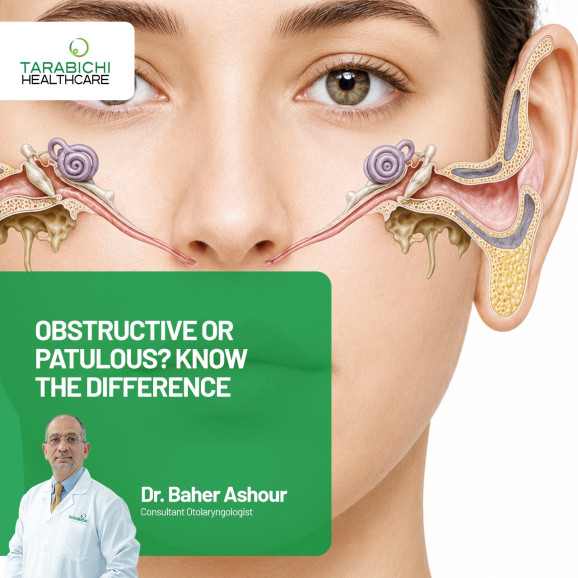
Medically reviewed By Dr. Baher Ashour
Ear pressure, aural fullness, popping and altered hearing are often grouped under the term Eustachian tube dysfunction. Yet this label can describe opposite mechanical problems. In obstructive Eustachian tube dysfunction, the tube does not open effectively. In patulous Eustachian tube dysfunction, it stays open when it should normally be closed.
The symptoms can overlap, but the treatment goals are very different. A procedure intended to open a poorly ventilating tube may be unsuitable for a tube that is already too open. Likewise, treatment intended to narrow a patulous tube would not correct true middle ear under-ventilation.
For patients researching Eustachian tube dysfunction treatment in Dubai, the most useful first question is not simply, ‘How can I unblock my ear?’ It is, ‘Which type of dysfunction is causing the symptoms?’
What Does the Eustachian Tube Normally Do?
The Eustachian tube connects the middle ear to the back of the nose, known as the nasopharynx. It is usually closed and opens briefly during swallowing, yawning and certain jaw movements.
Its main roles are to equalise pressure across the eardrum, clear middle-ear secretions and help protect the middle ear from sounds and material arising in the nose and throat. Healthy function depends on the tube opening when required and closing again afterwards.
What Is Obstructive Eustachian Tube Dysfunction?
Obstructive Eustachian tube dysfunction occurs when the tube does not open efficiently enough to ventilate the middle ear. Air is gradually absorbed from the middle ear space, which may create negative pressure behind the eardrum.
The eardrum may retract, and fluid may collect in the middle ear. Some patients have intermittent symptoms, while others develop persistent pressure changes or structural problems affecting the eardrum.
Typical Symptoms of Obstructive ETD
Common symptoms include ear pressure, a blocked ear sensation, muffled hearing, discomfort, popping or difficulty equalising pressure. Symptoms may become more noticeable during flights, diving, mountain travel or rapid altitude changes.
Some people feel temporary relief after swallowing, yawning or gently equalising the ears. Others cannot clear the pressure. Obstructive ETD may affect one or both ears and can be short-lived, recurrent or chronic.
What Can Cause Obstructive ETD?
Obstructive dysfunction may follow a cold or upper respiratory tract infection. Nasal allergy, chronic rhinosinusitis, inflammation near the Eustachian tube opening, enlarged adenoids and anatomical narrowing may contribute.
Persistent one-sided middle ear fluid in an adult requires careful examination of the nasopharynx to exclude a structural blockage. Not every blocked ear sensation is caused by allergy, and not every case of ear fullness is ETD.
What May Be Found During Testing?
Ear examination may show an inwardly retracted eardrum, middle ear fluid or reduced eardrum movement. Tympanometry, a test to measure middle ear pressure, may demonstrate negative middle ear pressure or a pattern consistent with fluid. A hearing test may identify conductive hearing loss.
What Is Patulous Eustachian Tube Dysfunction?
Patulous Eustachian tube dysfunction occurs when the tube remains open more than it should. This allows sound and pressure from the nose and throat to travel unusually freely towards the middle ear.
The problem is not failure to open; it is failure to close. This is why routine ‘ear-unblocking’ measures may be ineffective and may occasionally make symptoms more noticeable.
The Most Distinctive Symptom: Autophony
Autophony means hearing internal sounds unusually loudly. A person may hear their own voice booming or echoing inside the affected ear. Hearing one’s breathing in the ear is particularly suggestive of a patulous tube, although it is not diagnostic on its own.
Patients may also report fullness, fluctuating sound quality or a sensation that the eardrum moves with breathing. These symptoms can feel like blockage even though the tube is too open.
Clues That Symptoms May Be Patulous
Symptoms may improve when lying down, bending forward or during a head cold, when tissue around the tube becomes temporarily fuller. They may worsen with prolonged speaking, exercise, dehydration or weight loss.
Sudden weight loss, pregnancy, some neuromuscular conditions and previous surgery may contribute, but many patients have no single identifiable cause.
What May Be Found During Testing?
The eardrum may move in time with breathing, particularly while the patient is sitting upright and breathing through the nose. Tympanometry performed during breathing can sometimes document this movement. Findings may be absent when symptoms are not active.
Why Can Obstructive and Patulous ETD Feel Similar?
Both conditions can cause fullness, pressure, popping, tinnitus and altered hearing. A patient may therefore use the word ‘blocked’ even when the tube is abnormally open.
Similar symptoms can also arise from earwax, middle ear fluid, temporomandibular joint problems, migraine, sudden sensorineural hearing loss, inner ear disorders or superior canal dehiscence. Diagnosis should not be based on one symptom alone.
Why a Symptom Questionnaire Is Not Enough
Questionnaires can document symptom severity, but they cannot reliably identify the mechanism behind the complaint. A diagnosis should combine the history with ear examination, hearing assessment and tests selected for the suspected subtype.
A normal test on one day does not automatically exclude barochallenge-induced ETD or intermittent patulous symptoms. The timing, triggers and positional pattern of symptoms are clinically important.
Why Treatment Must Match the Type of ETD
Treatment for obstructive ETD aims to restore ventilation or bypass the pressure problem. Treatment for patulous ETD aims to reduce excessive openness or lessen the transmission of breathing and voice sounds.
Decongestants and Drying Treatments
A decongestant may temporarily reduce nasal congestion in selected obstructive situations, but it is not a universal ETD treatment. In patulous ETD, drying the lining or reducing tissue fullness may make autophony and breathing sounds more prominent.
Pressure-Equalising Exercises
Gentle swallowing, yawning or carefully performed pressure equalisation may help some obstructive symptoms. Repeated forceful attempts can cause discomfort and are not appropriate for every ear condition.
For a patulous tube that is already open, repeatedly trying to force it open does not address the mechanism. The patient may continue the exercises because the ear feels blocked, while the true diagnosis remains unrecognised.
Balloon Dilation
Balloon dilation of the Eustachian tube (BDET) is a minimally invasive procedure intended for selected patients with persistent obstructive Eustachian tube dysfunction after appropriate assessment. It is not a treatment for patulous ETD. An opening procedure may aggravate symptoms when the underlying problem is failure of the tube to close.
Treatments Intended to Narrow the Tube
Procedures designed to add tissue, alter the valve region or partly narrow the tube are considered only for selected, persistent patulous cases. Applying this strategy to a genuinely obstructed tube could worsen ventilation and middle-ear pressure.
How Does an ENT Specialist Tell the Difference?
Assessment begins with a detailed history. The clinician should ask whether the patient hears their own breathing, whether symptoms improve when lying down, whether they occur only during altitude changes and whether recent weight loss, nasal illness or surgery preceded the problem.
Otoscopy assesses the eardrum for retraction, fluid, scarring, perforation or movement during breathing. Tympanometry evaluates pressure and eardrum mobility. Audiometry checks hearing. Nasal endoscopy allows examination of the nasopharynx and Eustachian tube openings.
Further testing may be considered when symptoms remain unclear. The purpose is not to label every ear-pressure complaint as ETD, but to identify the most plausible mechanism and exclude important alternatives.
Treatment of Obstructive ETD
Treatment depends on duration, severity and cause. Short-lived symptoms after a cold may settle with time. Confirmed nasal allergy or inflammation should be managed appropriately. Persistent middle ear fluid, eardrum retraction or significant barochallenge induced symptoms may require additional intervention.
Ventilation tubes can bypass the Eustachian tube and equalise middle ear pressure, but they do not directly restore its function. Balloon dilation of the Eustachian tube (BDET) may be considered for selected chronic obstructive cases after examination and objective assessment.
Treatment of Patulous ETD
Initial care is often conservative. Depending on the individual situation, this may include maintaining hydration, avoiding unnecessary drying medication and addressing rapid or excessive weight loss where relevant.
Persistent, severe symptoms require specialist assessment. Treatment options vary and may include temporary measures or procedures intended to reduce excessive patency. Evidence for many treatments remains limited, so expectations should be discussed carefully.
When Should Ear-Pressure Symptoms Be Investigated?
An ENT assessment is appropriate when symptoms persist, repeatedly affect flying or diving, interfere with hearing, occur mainly on one side or include prominent autophony. Recurrent middle ear fluid, eardrum retraction, or unexplained hearing changes also require evaluation.
Sudden hearing loss, severe vertigo, facial weakness, significant trauma, ear discharge, or neurological symptoms require urgent medical assessment rather than routine ETD treatment.
Eustachian Tube Assessment at Tarabichi ENT
At Tarabichi ENT in Dubai, Eustachian tube assessment may combine ear examination, tympanometry, hearing testing and nasal endoscopy. The aim is to distinguish obstructive, patulous and barochallenge patterns while considering other causes of ear fullness.
Dr. Baher Ashour’s clinical work includes endoscopic ear surgery and balloon dilation of the Eustachian tube (BDET). A credible consultation should still begin with diagnosis and patient selection rather than assuming that every pressure complaint requires dilation or surgery.
Frequently Asked Questions
Can Someone Have Features of Both Types?
Symptoms may fluctuate, and other ear conditions can coexist with ETD. Rarely, a patient may show mixed or changing features. Reassessment during active symptoms may therefore be useful.
Does Hearing My Own Voice Mean Patulous ETD?
Not always. Voice autophony can occur in patulous ETD, but hearing one’s breathing is more suggestive. Other conditions can also amplify internal sounds, so examination is required.
Is Balloon Dilation of the Eustachian Tube (BDET) Suitable for Every Blocked Ear?
No. BDET is intended for selected obstructive cases. It should not be offered solely because a patient reports fullness or pressure.
Why Do Patulous Symptoms Improve When Lying Down?
Lying down can increase tissue fullness and blood volume around the Eustachian tube, which may help it close more effectively for a short period.
Conclusion
Obstructive and patulous Eustachian tube dysfunction can create similar sensations, but they represent opposite pressure regulation problems. One fails to open effectively; the other fails to remain closed.
The safest treatment begins with identifying the mechanism rather than treating the word 'blocked.' History, ear examination, tympanometry, hearing tests and nasal endoscopy help determine whether treatment should improve ventilation, reduce excessive openness, or address another cause entirely.
Patients with persistent or unusual ear pressure symptoms may benefit from specialist assessment before beginning repeated pressure exercises, decongestants, ventilation procedures or Eustachian tube dilation.